Tuesday, December 27, 2011

La Fromagerie - Let Them Eat Cheese

Everyone needs a Frenchman like Sebastien Tavel in his life.  This means you.  Mais pourquoi?  Because Sebastian possesses all the uniquely Franco-continental qualities that we Americans so desire in our French.  He's got great hair.  Looks dashing in a turtleneck.  Speaks with an impossibly charming accent.  Displays an impeccable taste in music.  But best of all, Sebastian owns a cheese shop.  And not just any cheese shop, friend-o.  Sebastien, along with his wife, Mary, the delightful American Southern belle she is, owns and operates the almost impossibly fantastic La Fromagerie in the historic Old Town, Alexandria, neighborhood of suburban Washington, D.C.

I confess to meeting Sebastien years ago and to loving him on first sight.  Here was a dark knight of the Washington food world, I thought.  A culinary hit man.  A gastronomic assassin in chef's whites who disguised a Marco Pierre White-sized passion for food perfection inside a French-hipster insouciance, a Gallic fuck-you kind of ennui, and who would just as soon as argue about the lasting importance of The Clash versus The Sex Pistols, than ever debate the merits of, say, sauteing your shallots in truffle oil instead of virgin olive.  

But as all too commonly happens in the food business, the trajectories of our respective careers required different courses, and I didn't see Sebastien again for several years until a sudden and unrelenting craving for really, really stinky cheese brought me, almost by accident, into Sebastien's La Fromagerie.    

Cheese guys are the esoteric wack-jobs of the food industry.  The Van Goghs of the business.  The purists.  And the culinary Green Berets.  They are the guys (and gals) who peddle still-living caseins of almost infinite variety of texture and flavor to a population of neophyte consumers whose grasp of cheese making and consumption goes little beyond Velveeta, and yeah, we know, that ain't cheese.  Those of us who work in the food business work with, and eat, cheese almost daily and know, truly know, precious little about the stuff.  Sure, I could hold forth, at appreciable length, about the differences between, say, Stilton and St. Andre, but the lecture would really be all smoke and mirrors, and dog and pony show, and about as nuanced as some professorial barfly discussing the difference between bourbon and tequila--an easy trick to pull off because each, Stilton and St. Andre, bourbon and tequila, is so profoundly different and unique.  We food pros are down with the wine guy.  We throw back with the sommelier several nights a week.  He's lied to our wives for us.  He's even driven us home and helped us up the porch stairs.  But the cheese guy?  He's the guy whom you really never get to know.  He's the mystery wrapped in enigma, the guy who played too much Dungeons and Dragons in his youth and grew up a gastronome.  He's also the guy who you, the food professional, with your profound lack of true cheese knowledge, never fails to disappoint.  

Except for Sebastian, the big daddy-o of French cool.  Now this guy has got your back.  Walk into La Fromagerie on any given day and stand slack-jawed before the cheese case, packed with often-local and always-artisinal American cheeses and Sebastian will guide you through an otherwise daunting gauntlet of choices.  He will ask you what you like in cheese.  Sharp or mild?  Goat or cow?  He will listen.  He will be patient.  He will let you speak.  He will nod.  Then he will remove cheese from his case, cut you a slice and offer it across the counter.  He will tell you to put it in your mouth.  And he will watch new culinary worlds open up for you and smile his Gallic smile.  Then he will walk you over to the wine case and teach you how to say vas te faire encule to your American compatriots with a perfectly delicious bottle of French rose.

My time in Paris, in that cold water flat in the Port de Orlean, taught me, out of an abject Orwellian poverty and necessity (re:  Down and Out in Paris and London, kids), that wine and cheese were French street food, that for less than five dollars American, I could walk into any Parisian grocery and walk out, minutes later, with a truly delicious and wholly satisfying lunch of wine, bread, and yes, cheese.  I spent glorious afternoons lunching in Pere Lachaise and on Montmartre, discovering revolution in the simple acts of drinking burgundy and eating brie beside the grave of Oscar Wilde, or on the street, with all of lower Paris laid out at my feet.  And if it wasn't to be cake for the Parisian masses, wine and cheese would duly, if not gloriously, suffice.  

To encounter Sebastien's La Fromagerie was no less a culinary epiphany.  Here was a guy, albeit one already known to me, who was offering the best, freshest cheeses and charcuterie to a tourist-heavy Old Town population greatly in need (whether the knew it or not) of gastronomic enlightenment.  Here was a guy bringing the Parisian street to the people.  Here was a guy selling a food product which, at its glorious best, and heterodox to the impulse of appetite, smells much like the white shit you dig out from under your big toe.  Here was a culinary gangster.  So I did what I knew I had to do.  I bought Sebastien's cheese.  I bought the Invierno, the Kentucky Tome, the Greyson, and I bought his charcuterie, the wild boar salami, the truffled salami, and his bread, and I went home and there went at this food purly intent on learning something, intent on truly paying attention to what I was eating.  And how often does that happen in this life?  The Japanese word for epiphany is satori, which translates as kick in the eye, not the actual eyes in one's head, I suspect, but the third eye of the soul, which for foodies might not be painted in red in the middle of one's forehead, as Hindu belief suggests, but sure-as-shooting tastes like pig fat and duck liver and, yes, leaves your breath smelling exactly like cheese.

So I ate my cheese and I ate my charcuterie and I told myself I had, if not learned about cheese, per se, learned what I loved about cheese, that its flavor changes with temperature and that it's flavor changes with the passing of days and that keeping it in my home fridge, exactly as it was, was like trying to keep a Genie in a bottle, or fresh bread fresh.  It was well above my pay grade.  And it simply couldn't be done.  

So when I hurried back to La Fromagerie to inform (or bore) Sebastien of my newly minted insights into all things cheese, I discovered this moody French bastard had now added a cafe to his cheese shop and that Sebastien, now once again sporting his beloved chef's whites, was churning out (from his open, one-man kitchen in back) such bold and daring lunch-time offerings as a braised pork belly sandwich, or a classic pork rillette, or house made head cheese and duck foie gras.  When I saw this, this miracle on King Street, I knew Sebastian was the mad French culinary genius I long suspected him of being.  I knew the day had come when a guy like me could walk off the street into a perfectly inviting cheese shop, sit down to a lunch of pork belly and cold French rose, and listen to Paul Simonon of The Clash sing The Guns of Brixton.  Then and only then did I truly know the new American food revolution had come.  Then and only then did I truly know the good guys had won.

Go to La Fromagerie.  Buy some cheese.  Buy some wine.  And for the love of the gods, buy some pork belly.  Happiness awaits.  Go and be happy.  And tell Sebastien I sent you.


Thursday, November 24, 2011

How To Spell Sunday in Chinese -- A & J Restaurant, Annandale, Virginia

Sundays are tricky.  The food business, such as it is, allows most of us, its devoted minions, but a single day's respite from its agony, its very specific grind and toil.  A single day to empty one's head, to vent one's spleen, to kick back and elevate one's feet in the wild hope the pain, both bodily and existential, will somehow abate, if not altogether, and magically, go away.  A single day of rest is all we so-called food professionals are allotted, and for me, that day is Sunday.  So where to cleanse this body and soul?  Church is clearly not an option for the deeply doubtful agnostic soul like mine.  So finding my own salvation in restaurants it must be.  Restaurants, where, for a golden hour or two, I can be cooked for, waited on, attended to, doted upon, and where, in that same magical hour, I can feed that karmic wheel in the sky and treat my cooks, my hostesses, my servers exactly how I long to be treated, with a generosity of heart, spirit, and, perhaps most importantly for them, a generosity of wallet .

So it is that my quest for food-borne salvation brings me to A & J Restaurant in Annandale, Virginia, on this balmy early-November midday.  Lucky for me, I know salvation almost always lurks in the strangest of places.  This place, this A & J Restaurant, is no exception.  For while Annandale, Virginia, might be one of the great culinary Asian hotspots in the Eastern United States, containing a mind-boggling number of first class Korean, Thai, and Chinese food joints, it is, as far as suburban towns go, a total shit hole.  It's suburban sprawl has suburban sprawl.  You would never, ever bring a date here.  No one you'd ever want to impress.  Annandale is downright nasty.  And so is the strip mall that houses A & J Restaurant.  It is, as suburban strip malls go, among the most homely and downtrodden I've ever seen.  It's a vintage 1971 model, and sits adjacent to a number of abandoned and bombed-out single family homes.  The neighborhood smells of ruin.  Of decay.  But it also smells of incredibly good Chinese food.  Freshly-cut scallions are in the air.  As is the unmistakable redolence of melted duck fat.  And fried pork.  Heaven smells of Chinese food.  Salvation clearly awaits here at the A & J Restaurant.  So I hurry in.


And this is where I ask you, dear reader, to imagine the sound of a record needle being dragged across twelve inches of vintage black vinyl.  Because my young family and I are the only white people here.  Because when we enter, everything stops, goes silent.  Talking.  Eating.  Moving.  Everything ceases.  And everyone looks at us.  Every person here is Chinese.  And they are, as a group, clearly thinking the same thing:  the white people are health inspectors, immigration police, or tourists who have taken a very wrong turn.  The hostess asks us in passable English is we need directions back towards Washington.  We need a table, we say with a smile.  So we share a table with another family, two elderly adults and their adult child, who, as it turns out, is visiting from Oakland, California, and is nearly the only one here who speaks English.  He kindly offers to help us navigate the menu.

"Circle the food you want," he says, pointing to the pencil on the table.  So we do.  We circle two bowls of noodle soup and six plates of dim sum.  It's a lot of food for the four of us, a blowout in fact, so the waitress considers our order and asks us, finally, if we'd like our noodles skinny or fat.  Both is what we tell her, and in no more than thirty seconds later we are rewarded with two steaming bowls of fried pork and fried chicken soup with house-made noodles, both skinny and fat, both incredibly fresh and delicious.


We slurp our soup loudly, as Chinese manners allow, and watch as the plates of dim sum starts to roll in.  First comes the Pao Cai, the pickled cabbage, which is simply a slaw of cabbage, red chili pepper, and whole pepper corns in rice wine vinegar.  The summation of flavors is hot, tart, bitter, and delicious.  Thai-like and nothing I've ever tasted of Chinese cooking.  Next comes the Ma La Er Si, or slicked pork ears, which my six-year-old daughter and I set upon with particular ferocity.  Sure, they are a bit springy and tough, but they're also sublime, earthy, somehow tart, altogether a rare treat.  The Chinese family at our table stares with open-mouthed incredulity.  The elderly mother speaks to her son in quiet Chinese.  The son nods his head, then speaks to us.

"My mother wants to know if you know what you're eating."

I tell him yes, that we are eating pig's ears, and that we're eating them with a pleasure that is truly keen.

The mother nods and speaks to her son in Chinese.

"My mother wants to know if you've told your daughter what she's eating."

I ask my daughter to describe the food presently in her mouth.

"Pig's ear," she says.

"We honor the animal by eating all its parts," I explain.


The son translates what I've said and his two elderly Chinese parents smile, then break into applause.  Whatever I've just said, whatever its translation, has just won them over.  They smile at us and pour us hot tea in our cups and nod their heads at us and pat our backs the way dog owners approvingly stroke their own pets.  White people we are no more.  We are something else.  Something sympathetic.  Knowable.  And that's when the rest of the dim sum starts to roll in.  When we've been deemed worthy by this Chinese family, part of the extended Asian tribe.  Scallion pancake, Pan Fried Pork Pot Stickers, Chinese Sesame Biscuit with Sliced Pork, Thousand Layer Pancake, and some of the best fried chicken (outside Old Town's fabled Blue and White) that I've ever eaten.  Plate after plate after plate of the best Chinese food I've ever put in my mouth.  This from a guy who hates (or so I thought)  Chinese food.  Cantonese and Szechuan cooking styles, with their endless parade of sauces thickened with corn starch and buttressed with the empty pop of MSG, have always left me, post-meal, feeling angry, cheap, dirty, ripped off, and somehow, in a purely culinary sense, fucked with.


Not at A & J.  Not here, brother and sister.  Every flavor is deeply honest, if not outright vibrant.  Every flavor is surely and unmistakably north-Chinese and starch-heavy, for sure, but it all manages to pull off the difficult trick (for Chinese food, at least) of appearing naked and fresh and vital and vulnerable to easy corruption.  Sauces laden with corn starch and MSG need not apply at A & J.  Here each protein, each vegetable starch, stands by its own merits and fails by its own shortcomings; food is allowed to succeed or fail nakedly, as it so goes in most Thai, Japanese and Korean cooking.

So is found my own Sunday salvation at A & J in Annandale, Virginia.  On this bright, balmy Sunday.  Here is Chinese cooking at its most humble and yet, most elevated.  Here is a restaurant full of Chinese nationals willing to share their most guarded culinary secrets with a white-American family of four in the naked light of Sunday.

And this is when the old Chinese man at our table leans over toward me and asks me, in perfectly passable English, where I'm from and if I've enjoyed my meal here today.

I'm from Missouri, I tell him, and I've never tasted anything like this.

He nods and smiles and tells me that he too has lived in Missouri, in Springfield, to be exact, and he informs me that Springfield is the home of the American movie star Brad Pitt.  This I know.  I ask him if he found Missouri, my home state, the state I so deeply love, to his liking.  He frowns and considers the question.

"It was slow there," he says.  "And the Chinese food wasn't so good."

No doubt.  Absent from professional palates was the cuisine of A & J Restaurant.  Go there if you can.  Venture into Annandale.  Sure.  You will find it sprawling.  You will find it ugly.  But you will find some of the best Asian food that this country has to offer.  Korean.  Thai.  And Chinese.  Especially Northern Chinese.  A & J Restaurant.  And share a table.  You never know who you'll meet or where they're from.  They just might be from China.  Or Missouri.

Wednesday, November 9, 2011

Manifesto: Chef Juan Mari Arzak and the Burning Bush

Manifesto: Chef Juan Mari Arzak and the Burning Bush: God speaks Spanish. And has three Michelin stars. I know this, because he has just spoken to me at this five-course luncheon, on this col...

Chef Juan Mari Arzak and the Burning Bush

God speaks Spanish.  And has three Michelin stars.  I know this, because he has just spoken to me at this five-course luncheon, on this cold, rainy mid-October afternoon, in the middle of Washington's Rogue 24 dining room floor for all here to see.  He touches my arm and speaks to me again, more slowly this time, almost languidly, the way an all-knowing abuelo will speak to a dimwitted, if favorite, grandchild at his knee.  He tells me, his head waiter charged with leading today's service, to slow down.  To concentrate.  To keep breathing.  To focus on what I'm doing.  He tells me that life in the Basque Country of Spain is not about speed.  Not about efficiency.  Not about rushing food from the kitchen to the table.  No.  That's gringo style.  The disease of North American fine dining.  Basque cooking is about taking one's time.  It's about the savoring the delicacy of life's many flavors.  It's about finding the reflection of one's very own soul in the pearly brine of an oyster shell.  And he tells me this, all of this, in Spanish.

"Entiendes lo que estoy diciendo?"

I tell him I understand everything.

"Claro, chef," I say.  "Si, claro.  Lo siento."

But I understand none of what he's trying to say.  Not just because my Spanish sucks (as clearly it must), but because this is a case of an oracle speaking directly to an acolyte from on-high.  Because this is a case of God speaking to Moses through the burning bush.  For while I might understand the words themselves and the sequence in which they're spoken, it's the concept of what's being said that I'm now struggling with, and mightily.  No doubt Arzak has already sized me up with his god-like acumen and spotted me for the food-professional impostor that I am, the foodie idiot savant.  I am not worthy.  Not to stand before him.  Not to serve his food.  He sees this or something like it in my face and smiles.

"Chill out, kid," he says in perfect English.  "Everything's going to be just fine." 


For those of you unfamiliar with the great chef, here's Arzak in a nutshell:  Three Michelin stars.  Chef/Owner of Arzak, a restaurant which international food writers routinely rate as among the world's ten best.  The reigning godfather of Basque Nuevo cuisine.  A true culinary heavy weight.  A living legend. A god of modern gastronomy.  

That I have well over ten years in the business and thousands of events under my belt should make me impervious to all the Food Network induced celebrity chef worship crap that goes with working with the likes of Arzak? 

Hardly.  That ain't the way it goes.

If nothing else, my hard-scrabble years in the food business evoke something just short of pure reverence for the great chef Arzak.

How so?  

Those of us who toil daily and largely anonymously in the industry find (if my may speak for my food brethren) all of this celebrity chef bullshit somehow analogous to the music business:  most rock 'n roll bands, however talented and good, never get signed, never land the big record deal; they are, almost all, relegated to the ash heaps of obscurity, a veritable dust bin of unlistened-to demo tapes, and dismissed to a life of "what-if's" and "almosts."  So it is in the food business.  Daily I am surrounded by ferociously talented cooks and servers, who will, for their entire careers, remain nameless and obscure in their glorious labor.  But that's the gig.  It's what they've signed up for.  It's a given.  You live in the moment.  And when that moment has passed, you move on to the next.  Not until the advent of the Food Network, and still as rarely as lightning gets trapped in a bottle, had anyone (with exemptions allotted to Child and Pepin) risen to true celebrity in the food business.  Only very rarely does this world allow a skinny, big-toothed, knock-kneed punk-rock drummer from suburban Northern Virginia to become Dave Grohl.  Only more rarely does the world allow a Vassar-dropout-cum-brunch cook-cum-junkie become to Tony Bourdain.  And we celebrate those who have gone before, whom have triumphed.


So what, then, to make of this culinary titan before me, this Chef Juan Mari Arzak, for whom our own Food Network/Travel Channel celebrity chefs swoon and revere?  Arzak, I suspect, knows little of such things.  Here is a man, born in 1942, and who came of culinary age when apprentice chefs were physically beaten, and whose stations were, in the American parlance, fixedly blue collar.  

The luncheon for which we're working is for 27 guests.  And it's to celebrate the food and wine of the Basque region of Spain.  All Arzak has to do is show up in his whites, shake a few hands, and smile.  His vast international celebrity can do all of the heavy lifting for him.  It's a veritable walk in the park.  I would know.  I've been working with his advance team of sous chefs for the past two days.  Everything's been prepped; every culinary contingency met; nothing left to chance.  All Arzak has to do is show up and smile.  

But no.  He enters the kitchen and rolls up his sleeves.  He means business. 

And this is why, in a silly blog decidedly about the glories of street food, of populist cuisine, that someone the likes of Arzak shall appear, stars and all.

Because he brings a ferocious Basque-cum-American blue-collar ethic to his cooking; because he is seemingly oblivious to his own celebrity; because he's a man of the people, a man of the street.  I watched him fix an unworthy sauce seconds before plating.  I watched him berate (in hushed, god-like tones) one of his sous chefs for not having a section of beef cheek at proper serving temperature.  I watched him plate every single course, and touch every single plate, that came out of that kitchen.


Is this the life of a so-called celebrity chef?  Is this what international acclaim brings to a no-brainer of a lunch for 27 dim-witted Washingtonians who merely need the famed chef to clap like a seal to feel nourished and well-fed?  No.  This is the work of soldier, who, for no matter how many Michelin stars may be pinned across his chest, will forever fight the good fight, and no doubt die with his culinary boots on.

I salute you, Chef Arzak.  And yes, Chef, I am working on my Spanish.

At this very moment.

And that's a promise. 


Friday, October 21, 2011

Honduras Bites Back - A Ride on Con Sabor a Mi Patria

Now this a food truck.  A twenty-year-old delivery truck retrofitted with propane heat and refrigeration, parked in the crowded lot of a supermercado latino, and badly hand-lettered, curiously enough, on its side with the words Con Sabor A Mi Patria, whose literal word-for-word translation is with flavor of my country.  For our purposes, we'll call her Flavor Country.  We'll call her a food truck in its purest form.  Not the kind that peddles sprout wraps to Federal luncheoneers on their noon breaks.  Not the kind that traffics to yuppie foodie douchbags questing for the most authentic turkey burger on wheels.  Not the kind that sells you cupcakes, the crack of food nostalgia that robs you of real childhood memories one red velvety bite at a time.  No.  This truck is the real deal.  A direct blood descendent of the chuck wagon, or better, those silver-gleaming roach coaches that first brought hot breakfasts and lunches to an army of American laborers, and which allowed iron workers and welders, for the very first time, to return to work with hamburger grease on their fingers and yellow mustard on their chins.  This is what Flavor Country surely represents.  A mighty gastronomic ship of authentic Latino cuisine.  A truck that repudiates, with a perfectly pitched fuck you, the current food truck fad of falafel trucks and frozen yogurt stands rolling around Washington on oversized Firestones.  Flavor Country calls to me like a siren's song.  And it would take a veritable army of health inspectors to keep me away.

The first thing I realize about Flavor Country is that ordering in English is not an option.  This is a Spanish-only operation, boy-o, not just in cuisine, but in language as well.  There are two women inside Flavor Country.  Both middle aged.  Both with gold teeth and hair dyed the color of a Texaco sign.  They look at me with the smiling wonder of tourists watching of a Yellowstone Grizzly wander up to their minivan intent on walking away with a belly full of food.  I nod at the women and smile back.  Greetings and salutations are perfunctorily polite and one of the women inside Flavor Country points me to the menu painted on the side of the truck.  What I see are all the familiar classics of Central American Cuisine.  Pupusas.  Carne Asada.  Baleadas.  Bistec Encebollado.  They're all here.  The menu is a hall of fame of Latino gastronomy.  What I fail to notice, however, is the large Honduran flag painted bottom and center of the menu.  But I've already blown through a thousand STOP signs in my adult life, so why fret over just one more left in my rearview mirror.

After a moment's contemplation, I decide to go with the two all-too-familiar golden oldies of Latino cooking:  tacos and enchiladas.  I know, I know.  This is the gastronomic equivalent of asking to hear a band of pimpled eighteen-year-olds with knock-off brand Les Pauls cover Stairway to Heaven, a song no one, and I mean no one, needs to hear ever again.  Ever.  But in my defense, by hearing those pimpled eighteen-year-olds butcher (or not) Page and Plant, by hearing if the singer can handle Plant's vocal range or Page's quiet masterpiece of a guitar solo, you'll quickly know if this band is any good or not.  So it is with my order of tacos and enchiladas, con todo, y muy caliente.  One bite of each dish, and I'll know if Flavor Country is as great as she appears to be, the food truck of all food trucks.  The mothership of ethnic flavor.  But something in my order has troubled the cooks.  The women inside the truck discuss my request in hushed voices and at troubling length.  A minute goes by.  Then two.  They shake their heads and argue quietly about some culinary impasse I've created with my order.  They bicker a moment longer, then inform me, their waiting customer, that my stomach is simply not suited for what I've asked for, that con todo may, in fact, complicate my life in ways I will surely find unpleasant.

"Soy gringo, si, pero mi estomago es muy fuerte," I assure them.

They look dubious of my claims of intestinal fortitude, then share a no me importa shrug and go about the business of cooking my lunch.  While one woman is bent over the flattop grill, searing the animal protein of my lunch, skirt steak and ground beef it would appear, the other asks me what I'd like to drink.  The question catches me off guard.  I'm so wrapped up in watching the woman work the propane-heated grill that I balk at the matter of a culinary chaser.  So I order a Coke.  This is not something I often drink in life.  Not that I have anything against cola, per se.  I do, however, kindle a pure and unadulterated hostility against high-fructose corn syrup.  It's the devil in your drink.  The Type ll diabetes in your can.  High-fructose corn syrup can go fuck itself.  But it's what I end up drinking with my lunch.  And it represents yet another STOP sign that I blithely blow through on the way to the gastronomic calamity I'm about to experience.  The can she hands me has just come the low-boy reach-in refrigerator, and yet it's almost warm to the touch.

Danger Will Robinson.

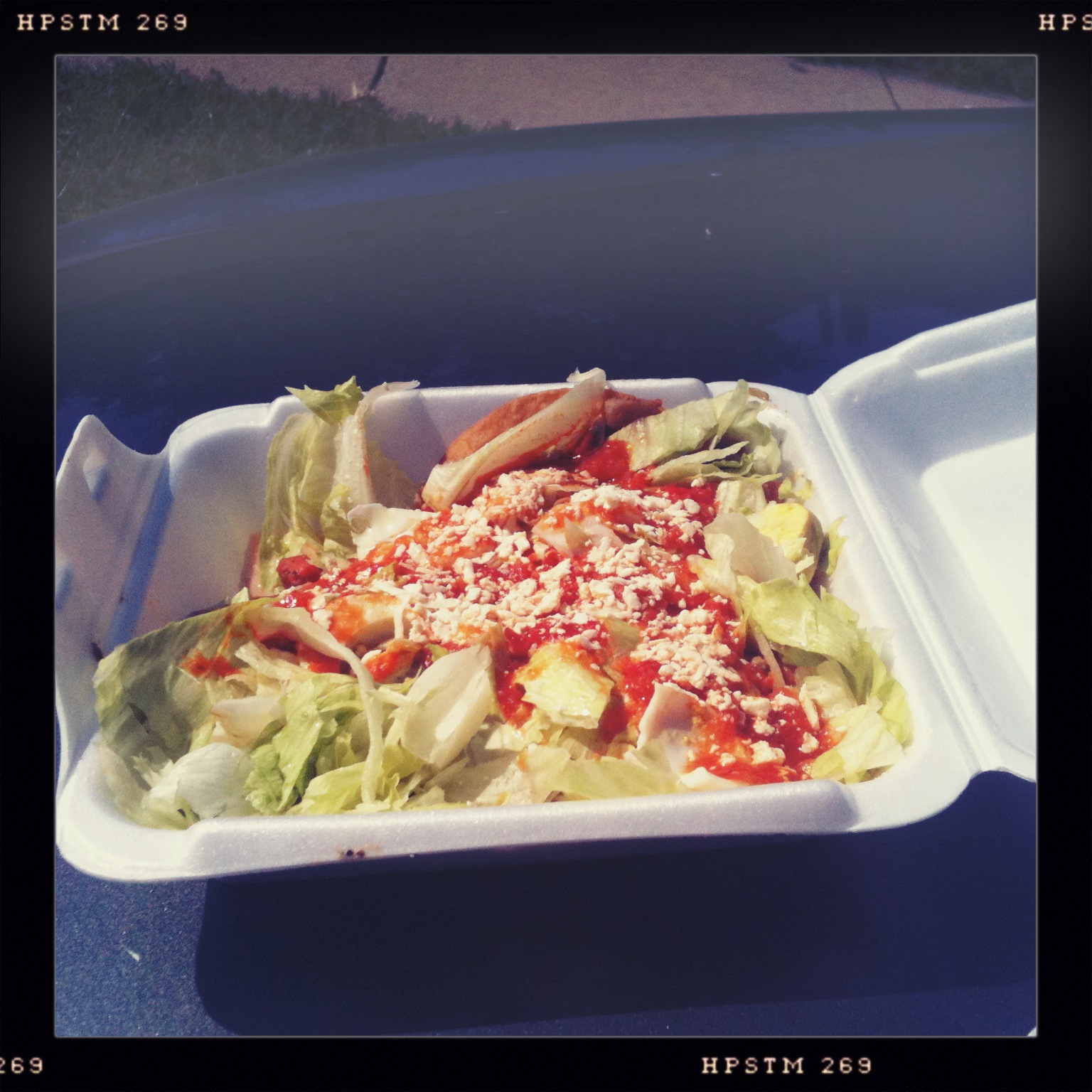
Another minute or two later, and my lunch is ready, delivered in styrofoam clamshells and bagged in plastic.  I smile, pay, bid the cooks of Flavor Country a heartfelt adios, and abscond with my lunch like someone at a yard sale who has just purchased an original Jackson Pollock for the price of a single, 1983 copy of Mad magazine.  To the victor go the spoils, as they say.  And yet, when I find a favorite nearby park bench and open the clamshell containing my enchiladas, something is not quite commensurate with triumph.  The enchiladas have been served open faced, over fried flour tortillas, and topped with a nearly unrecognizable melange of iceberg lettuce, farmer's cheese, and a near-tasteless red sauce which eerily resembles blood.

So I put that clamshell aside and move on to the tacos.  Everything amiss in the world can be righted by a good taco, yes?  Or no.  These tacos seem anemic somehow.    Lifeless and pale.  They are, without question, fully recognizable as tacos, but, on closer look, appear as taco imposters, taco doppelgangers, who might have mastered the look of a taco, but who have somehow botched the task of learning the taco's essence. 

Okay.  Perhaps I've judged too hastily.  I've let appearances taint what will otherwise be a tasty and truly authentic Honduran culinary experience.  Presentation is for suckers, right?  It's what lives at the end of your fork that really and truly matter, no?  So return, do I, con el tenedor, to the enchiladas.  I go at them.  I tear them up.  I really shovel it in.

And I am deeply unimpressed.

What I find under all that farmer's cheese and iceberg lettuce is a greasy mess of unseasoned ground beef, hard-boiled eggs, lima beens, peas, and carrots.  It's the everything-but-the kitchen sink approach to gastronomy that is the signature of nations whose cuisine was born from pure and abject poverty, and where the inclusion of such dispirit ingredients speaks to a wealth only imagined, far off in a future that never comes, and wealth that is never ever real.

So I quit while I'm still ahead and yet cramp-free, and move on to the tacos.  Put me on death row and have me choose a last meal, and if the prison kitchen is out of fried chicken and pork ribs, then for my last meal tacos it will be.  But not these tacos.  Not on your life.  One bite unmasks these tacos for the tacos they were only pretending to be.  What had appeared to be skirt steak is a form of protein heretofore unknown to me (which leaves only monkey for those of you keeping score at home).  The corn tortillas have been steamed into a soggy state of limp flavorlessness, and what little seasoning adorns the protein comes in the form of an impotent dice of cilantro and onion.

Fail.  Abort.  This food sucks.

Or does it?  Is the food really this bad or have I brought my yuppie Anglo expectations to a national cuisine that defies such notions of cultural and culinary short hand?  Does it mean that because I've once had the dubious pleasure of eating a hamburger from, say, McDonald's, all other hamburgers, however "authentic," that fail to resemble the McDonald's prototype suck despite their own merits?

Would I be better off waiting in another food truck line for turkey burgers and falafel and veggie wraps, and eager, as I should be, to pay with my earth-friendly debit card (because, Dude, Cash = Slavery, or haven't you heard)?

Or does the question of my hating this food get even trickier?

Does that fact that this food comes from an "authentic" Honduran food truck render it intrinsically better than the far tastier faux-ethnic food at, say, Baja Fresh, which, in my albeit limited experience, is also prepared by "authentic" Latino line cooks over open flame.

Yes and no.  None of the above and all of the above.  Simultaneously and never at the same time.

Which is to say that while the food of Flavor Country might very well be truly delicious, truly authentic Honduran food, and most excellent on its own cultural and gastronomic terms, this gringo palate prefers to pass on it as a national cuisine.  Chalk it up to my own shortcomings and my own ruin as an eater at the hands of all the Mexican street cooks I have known, and whose wily use of low heat to break down beef fat in its sundry forms (think tongue and brains) and whose ability to highly season food with a few simple, elemental spices (think cumin and chili powder for starters) have proven, for this stupid white man, at least, positively transcendent, time and time again.

Have I failed my lovely lady friends of Flavor Country?  Perhaps.  Perhaps they too failed me, however.  For how did I spend next several hours contemplating my culinary experience?  In a pose made famous by Rodin's The Thinker while doing a Jackson Pollock on my own toilet bowl.

This gringo finds himself attached to the miracle of modern refrigeration.

I'll see you tomorrow at Baja Fresh.

Hasta nunca, Con Sabor a Mi Patria.


Thursday, September 22, 2011

Manifesto: Manifesto: Never Look Back - Lunch at the 29 Taste...

Manifesto: Manifesto: Never Look Back - Lunch at the 29 Taste...: Manifesto: Never Look Back - Lunch at the 29 Tastee Diner : I can't say I wasn't warned. The admonitions are everywhere. They are like roa...

Manifesto: Never Look Back - Lunch at the 29 Tastee Diner

Manifesto: Never Look Back - Lunch at the 29 Tastee Diner: I can't say I wasn't warned. The admonitions are everywhere. They are like road signs urging you to stop, turn around and head in the oppo...