It’s what American cities do best. They change. When they improve, we call it urban renewal. Gentrification. Gastronomic manifest destiny. Whatever you call it, it first appears, innocuously enough, as the new corner Starbucks. Then it transmogrifies into a hipster burger joint. Then it shape-shifts into that Whole Foods built where the old A & P used to be. And before you can say Kenny G., the entire neighborhood is swarming with white people. Like it or not, that’s how gentrification works. For those professionals able to afford such free-wheeling luxury, these newly minted cityscapes represent a fairyland of easy living. What’s not to like about being able to score a pound of prosciutto, your own dry cleaning, and a cup of bubble tea in the space of one city block? I, for one, will cop to it. Guilty as charged. Without a doubt. Were I to live in such a neighborhood, I would certainly be that guy carrying a chai latte in one hand and my pet Chihuahua in the other. Or, well, maybe not.
But what do we call it when this kind of renewal happens in reverse? What do we call it when a brown person improves on what a white guy first tried? What do we call it when a Salvadoran cook and entrepreneur buys a terribly rundown but long-cherished family marketplace in a traditionally all-white neighborhood (with a golf course across the street) and turns the place into one of the most unlikely and easily most delicious purveyors of Salvadoran food around? I call it progress. I call it Pat’s Market in Alexandria, Virginia, and Pat’s is exactly what culinary revitalization tastes like.

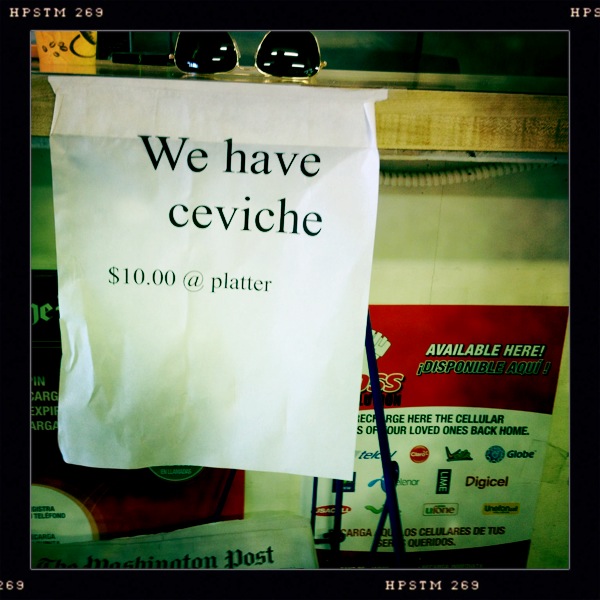
I won’t kid you; imagining culinary excellence coming from a place like Pat’s takes more than creativity; it requires the kind of blind faith known only to sky-divers and bungee jumpers, and which tells them, against all reason, that everything is going be all right in the end. That no one is going to get hurt. Pat’s is more than down-at-the-heels and rough-around-the-edges. It’s dangerous-looking. The kind of place that looks to serve up complimentary sides of hepatitis and botulism with every order. The kind of place that appears to have brought a third-world sensibility of safe-food-handling practices to compliment its third-world cuisine.
But that first-take on Pat’s would be shortsighted. Myopic. For what the true gastronome sees when he enters Pat’s is not the shelves of potted meats, the hanging bags of pork rinds, the displays of LIVE BAIT. No, what the real eater first spies is the Salvadoran couple behind the counter. The el who is filling an old ketchup squeeze-bottle with salsa. The ella who is swaddled in a white cooking apron and stands beside a four-burner range and a flat top grill. Ah! Food is cooked here, is the gourmand’s first epiphany. What the savvy eater next essays is the menu printed on copier paper and taped to the counter like the report card of someone else’s honor student, someone else’s kid. The hanging menu offers cheeseburgers, French fries, wings, pizza. The menu is a red herring, a gastronomic sleight of hand, an expert exercise in culinary misdirection, is the gourmand’s second insight. Something strange is afoot here. Pat’s Market has my full and undivided attention.
So I ask the man behind the counter for something to eat. Lunch is what I need. The request makes him go all shifty-eyed, makes him nervous. That or my short-hair/Ray Bay aviator approach to personal aesthetics which screams health inspector and la migra to guys like this everywhere. The proprietor motions to the menu and suggests the cheese steak. The cheese steak? I tell him I work in the food business. Not some pinche zapatero, but a careerist. A lifer. I tell him I won’t eat gringo food on my day off. This makes him relax, visibly. His shoulders fall forward and he lets out his breath. I think I even detect a smile. When the man suggests pupusas I know we’re destined for friendship, he and I. When he suggests a tongue taco, I know it’s going to be a culinary love between us, real and true. Such things happen when a perfect stranger reads the secret desires aflame in your soul. And sometimes a tongue taco is all it takes.

But as with all young love, things can get really strange really quickly. The proprietor comes around from behind the counter and walks to the very back corner of the store. There, he enters a mid-century walk-in unit that looks like a bank vault, and once in, stays inside for a good seven minutes. I know it’s a full seven minutes because the cook doesn’t speak English. Because there’s no one else inside the store. And because I take out my iPhone (that requisite douchewear accessory of foodies everywhere) and seek an app designed to somehow defeat awkward situations such as this. Just as I thought: there is no app for that.
The proprietor emerges with two metal mixing bowls filled with meat. The cubed tongue in one hand. A bowl of diced flank steak in the other. He passes by me without a word and once behind the counter, begins to season and toss the meat with his bare hands. The woman warms the pupusas and tortillas on the grill, and once brown at the edges, removes the starches to make room for the meat. And in what feels like just seven exhilarating seconds, I am presented with two styrofoam clamshells full of what smells like really good Salvadoran food and for which I am charged a pittance (two tacos, two pupusas and Mexican Coke for well under ten dollars).
I smile, pay, and abscond to a nearby park where I plan to eat what I hope might be, at best, barely-eatable Salvadoran food consumed in the warm sunshine of a late-winter’s day. At the very least, I hope to be full at meal’s end. And if I am to get my greatest wish, if there is an Easter Bunny after all, the food will not make me sick.

The beef taco is rich in flavor, vibrant, grassy, highly seasoned and, somehow, altogether familiar tasting. The tongue is, simply put, the best tongue taco I’ve ever tasted insofar as the flavors are spot-on and that it is more of a melting process (as opposed to the regular seven-chews-per-bite gringo mastication routine) that delivers the tongue down my gullet. The tacos are made of the freshest tortillas I ever recall eating. And the pico de gallo that comes in the clamshell—fresh enough to be called bombastic. I pick it apart to discover a rough and irregular dicing of the tomatoes and onions that delivers the most significant epiphany of the day: this food is homemade.
So I do something I’ve never done before. Something foolish. I go back. I get in my car and drive back to Pat’s Markets. I want an explanation. I want an answer to a single question: how can their food be this fucking good? The couple behind the counter does not look happy to see me again. Have I come back to bust them on the internal serving temperature of their flank steak? Or have I come back to avenge the bone in my throat? The same gringo in the space of half and hour surely means bad, bad things are about to happen. Things involving knife fighting and deportation. So I smile and offer my business card and try to put them at ease with assurances that their food is, in my opinion, easily the best Salvadoran fare in the area. They already know this. But saying so puts the proprietor at ease. Introductions are made. His name is Manuel, hers Janira. They purchased the already-distressed Pat’s Market six-years before from an Indian family, all Hindu and vegetarian, who sold (but never ate) high-end deli meat (the market was built in 1960 and named for the long-dead original owner’s still-living wife). Manual does a respectable business selling traditional Salvadoran food to always-ravenous Latino laborers, breakfast and lunch. The menu taped to the counter is for the benefit of stray gringos who wander into Pat’s without fully understanding that the United States end in the parking lot outside. Inside Pat’s, they’re in El Salvador, no two ways about it. You're off the reservation, pal.
But the food, I ask Manuel, how do you do it? How do you make it taste like that?

My first impulse is to bolt. I’ve been had. Taken for a sucker. Played for the kind of gringo fool who can’t tell the difference between authentic Salvadoran food and gastronomic hocus-pocus. But one hard look at Manuel convinces me otherwise. Here is this sweet little man who came from profound third-world poverty with no money, no English—just the dream of taking some ruined old gringo grocery and piloting that leaky old thing toward culinary greatness. One hard look at Manuel reminds me to ask myself on just what third-world gastronomy is based, after all. Third-world cuisine is about taking whatever ingredients are at hand, be they queso fresco or provolone, alguashte or French’s yellow mustard, and making the most delicious food possible. So the very impulse that drives Manuel and Janira to season their food with North American condiments is exactly what make their Salvadoran tacos and pupusas authentic.
Manuel and I shake hands as I am leaving. He tells me he hopes I will return for more tacos. Come back for the best and most authentic Salvadoran food I’ve yet had the pleasure to taste? Of course I will. Because Pat’s continues the heritage of culinary revitalization of America. Because it’s what the future tastes like. Because it’s deeply and truly delicious.
Pat’s Market is located at 1401 Belle Haven Road, Alexandria, Virginia, 22307.
I can’t wait to see you there.
[Reader's note: word on the street is that Pat's has closed. Bummer.]

[Reader's note: word on the street is that Pat's has closed. Bummer.]